

IVD Performance Evaluation: best practices for drafting the PER across Analytical, Clinical, and PMS Data

Performance Evaluation is the process by which a manufacturer demonstrates that an in vitro diagnostic medical device (IVD) meets the applicable general safety and performance requirements set out in Regulation (EU) 2017/746 (IVDR). The evaluation encompasses scientific validity, analytical performance, and, where applicable, the clinical performance of the device.
Drafting the Performance Evaluation Report (PER) alone is not enough. Performance Evaluation must begin with structured planning, be maintained throughout the entire life cycle of the device and incorporate newly available evidence, including data originating from Post-Market Surveillance (PMS) and, where appropriate, Post-Market Performance Follow-up (PMPF).
For manufacturers, this means designing an evidence strategy strictly aligned with the intended purpose, the technical characteristics of the device, stated claims, and associated risks. Therefore, the overall quality of the Performance Evaluation depends not on sheer data volume, but on data relevance, methodological rigor, and the capacity to robustly substantiate conclusions on device performance.
IVD Performance Evaluation: where to begin?
Performance Evaluation should be established as a structured, iterative process where evidence planning, experimental appraisal, and post-market intelligence remain interconnected.
The starting point is the Performance Evaluation Plan (PEP), which outlines how the required evidence is to be gathered, appraised, and integrated. The findings and substantiated conclusions are subsequently documented in the Performance Evaluation Report (PER).
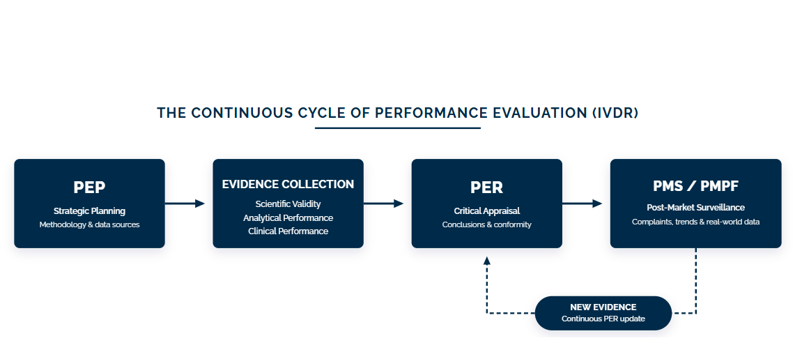
Following commercial placement, the manufacturer continuously captures and reviews real-world information through Post-Market Surveillance (PMS) activities (complaints, customer feedback, trending data, vigilance). Where appropriate, Post-Market Performance Follow-up (PMPF) further enables the generation and assessment of clinical performance data in routine operational settings.
These insights supply fresh evidence for the Performance Evaluation, triggering a formal PER update when indicated. Consequently, Performance Evaluation does not conclude upon initial report issuance; it evolves continuously throughout the entire life cycle of the device.
PEP vs PER: What Is the Difference?
The PEP and the PER serve distinct yet complementary regulatory functions:


In practical terms, the PEP defines how the evaluation is to be conducted, whereas the PER details what was evaluated and the conclusions established.
The three pillars of Performance Evaluation
Under the IVDR, Performance Evaluation is a continuous, integrated process designed to verify conformity across three core pillars:
- Scientific Validity
Demonstrates the biological, physiological, or pathological association between the analyte (or marker) and the clinical condition of interest. Key evidence sources include:
- Peer-reviewed scientific literature.
- Recognized consensus guidelines and clinical recommendations.
- Epidemiological data and pathophysiological background.
- Analytical Performance
Demonstrates the device’s capability to correctly detect, identify, or quantify the specific analyte. Depending on the assay format and intended purpose, relevant parameters include:
- Accuracy and precision
- Repeatability and reproducibility
- Analytical sensitivity (limit of detection and quantification, LoD/LoQ)
- Analytical specificity
- Measuring interval and linearity
- Cross-reactivity and potential interferences
- Stability
- Clinical Performance
Demonstrates the device’s ability to yield results correlated with a defined clinical condition or target physiological status in the designated population and operational setting. Core metrics include diagnostic sensitivity, diagnostic specificity, positive/negative predictive values (PPV/NPV), likelihood ratios, and ROC curve analyses.
What Evidence Is Required for an IVD Performance Evaluation?
No universal evidence package applies to all IVDs. The evidence generation strategy must be customized to the risk class, analytical methodology, and specific claims of the device.

The IVDR establishes that Clinical Performance Studies must be performed unless the manufacturer provides robust justification in the PEP for relying on alternative clinical data sources deemed sufficient to support the intended purpose and claimed performance.
When are new studies or testing activities required?
Throughout Performance Evaluation, the manufacturer must proactively identify data deficiencies (evidence gaps) to implement necessary corrective actions (supplementary bench testing, analytical re-validation, or prospective clinical studies).
The need for additional testing or studies typically emerges when:
- The intended purpose is expanded or new claims are introduced
- Device design, raw materials, or core technologies change
- Existing data lack statistical representation across the intended patient population or use environment
- Emerging post-market trends or newly identified risks arise from PMS
PMS and PMPF: keeping Performance Evaluation up to date
Performance Evaluation is intrinsically tied to the Post-Market Surveillance system. Post-market intelligence continuously verifies that the device’s benefit-risk profile remains favorable throughout its operational life.
Relevant inputs include complaints, trending reports, incident registries, clinician feedback, recent scientific publications, data from equivalent or comparable devices (subject to substantiated technical and clinical equivalence), and PMPF outputs.
If a manufacturer concludes that PMPF is not appropriate for a specific IVD, a detailed technical justification must be formulated within the PEP and documented in the PER.
PER Update Intervals (Article 56 IVDR)
- Classes C and D: updated continuously as needed and at least annually.
- Classes A and B: updated when emerging PMS or PMPF findings warrant revision.
5 Best Practices for Robust IVDR Performance Evaluation
- Always Anchor Strategy to Intended Purpose: The intended purpose dictates the evaluation roadmap. All gathered evidence must directly substantiate target populations, assay boundaries, and explicit performance claims.
- Critically Link Evidence to Conclusions: The PER is not an uncritical compilation of external citations. It must articulate a clear, documented rationale connecting raw data to substantiated conclusions.
- Qualitatively Appraise Literature: Large publication volumes do not inherently ensure regulatory compliance. Evidence must be screened for methodological rigor, statistical power, and direct technical relevance to the device.
- Integrate PER with PMS: Post-market monitoring and performance evaluation operate as a closed loop. Real-world utilization data must systematically refresh the technical file.
- Identify Evidence Gaps Early: Detecting data deficiencies well in advance of Notified Body submission avoids costly regulatory freezes and review delays.
Timeline planning: transitional deadlines under Regulation (EU) 2024/1860
Manufacturers must align testing schedules and PER development with the extended transitional deadlines introduced by Regulation (EU) 2024/1860 for legacy devices (devices placed on the market under Directive 98/79/EC):

Because submitting a formal conformity assessment application requires a fully mature technical file with an approved PER, identifying evidence gaps early is vital to scheduling laboratory testing and securing market continuity.
Conclusion
Performance Evaluation under IVDR is not a administrative checkpoint to complete at the end of the compliance process. It is a continuous, lifecycle-spanning framework that connects scientific validity, analytical performance, clinical performance, PMS, and PMPF. For manufacturers, a successful strategy relies on starting from the intended purpose, qualifying evidence rigorously, and addressing data gaps through targeted laboratory testing or dedicated clinical investigations.
In-Depth Resource: download our complete guide to IVDR
For an extensive operational overview of Regulation (EU) 2017/746—covering qualification, classification rules, Basic UDI-DI grouping, technical documentation authoring, Notified Body interactions, and transitional extensions under Regulation (EU) 2024/1860:
👉 [Download the White Paper: Guide to Regulation (EU) 2017/746 (IVDR)]
>>> Complife delivers integrated support for Medical Device and IVD manufacturers, combining strategic regulatory consulting and laboratory testing. From performance evaluation management to laboratory testing for safety, biocompatibility, and performance, we assist companies across every stage of IVDR compliance.
[Contact Complife experts for a consultation]
